
How Many Printed Materials Should Your Business Order?
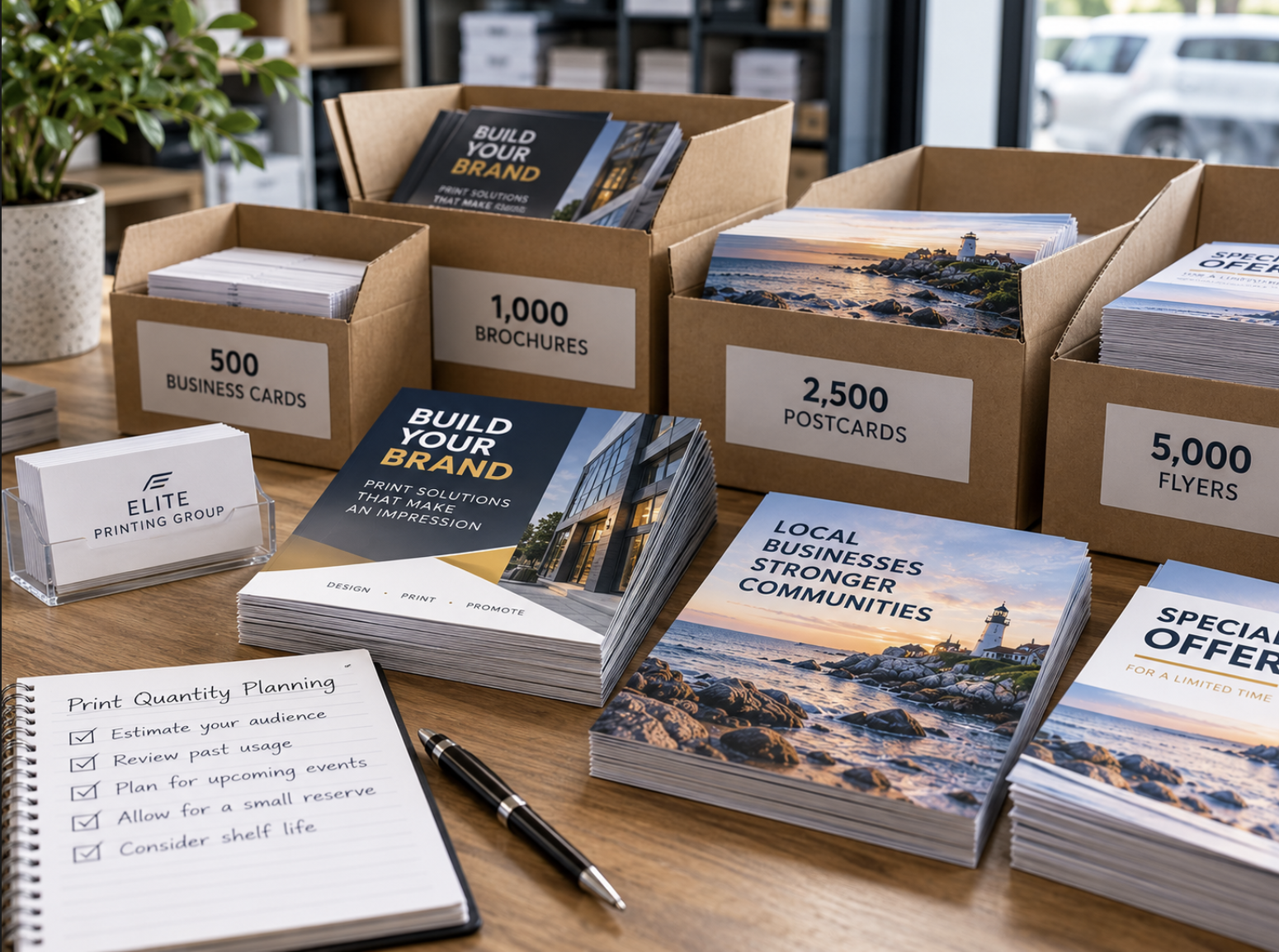
When planning a commercial printing project, one of the first decisions businesses face is determining how many pieces to order. Whether you're purchasing business cards, brochures, promotional flyers, postcards, or other marketing materials, choosing the right quantity can affect your budget, inventory, and overall marketing plans.
Ordering too few materials may leave your team without the supplies it needs for an upcoming event or customer interaction. Ordering too many, on the other hand, can result in unused inventory, unnecessary storage, and printed pieces that become outdated before they're distributed.
The challenge is finding a balance between having enough materials available and avoiding quantities that exceed your actual needs.
While there isn't one universal formula that works for every project, a thoughtful approach to estimating demand, reviewing past usage, and understanding printing costs can help businesses make more informed ordering decisions.
Here's how to evaluate the quantity that makes sense for your next commercial printing project.
1. Start by Understanding How the Materials Will Be Used
Before deciding on a quantity, consider the purpose of the printed materials and how your business plans to distribute them.
A company ordering business cards for its employees has different needs from a retailer preparing flyers for a short-term promotion. Similarly, a nonprofit planning a fundraising event may need printed programs for a specific audience, while a professional service provider might distribute brochures throughout the year.
The intended use helps establish a realistic starting point.
For example, a business preparing for a trade show might estimate how many meaningful conversations it expects to have and how many attendees are likely to receive brochures or business cards.
A company that keeps marketing materials at its front desk could review how many pieces are distributed during a typical month.
If the materials will be mailed directly to customers, the planned mailing audience may help determine the required quantity.
The important distinction is that print quantity should be based on expected use rather than simply choosing the largest available order.
Begin by identifying where, when, and how the materials will be distributed. From there, you can build a more practical estimate.
2. Review Previous Orders and Actual Usage
For materials your business orders regularly, past usage can provide one of the most useful starting points.
If you've ordered brochures, business cards, postcards, or other materials before, review how many pieces were purchased and approximately how long they lasted.
For example, imagine a business ordered 1,000 brochures and distributed most of them over five months. That history provides a useful indication of its average monthly demand.
However, historical usage shouldn't be treated as a fixed prediction.
Upcoming trade shows, seasonal promotions, new employees, changes in customer traffic, or new service offerings can affect how quickly materials are used.
Businesses should also consider whether previous orders were unusually large or small.
If an earlier order included extra inventory for a special event, that quantity may not represent normal ongoing demand.
When reviewing previous orders, ask:
- How many pieces were purchased?
- How long did the materials last?
- Were any left unused?
- Did the business run out before the next planned order?
- Were there unusual events or promotions that affected demand?
- Is the information still current and likely to remain useful?
Even approximate answers can help create a more realistic quantity estimate.
For businesses that order multiple types of printed materials throughout the year, maintaining a simple record of quantities and reorder dates can make future planning easier.
3. Estimate Demand Using a Simple Calculation
You don't need complicated inventory software to create a reasonable estimate for many common printing projects.
A straightforward approach is to multiply your expected distribution rate by the period the materials need to cover, then consider whether a modest reserve is appropriate.
For example, suppose a business typically distributes approximately 150 brochures per month and wants enough inventory for the next four months.
The basic calculation would be:
150 brochures per month × 4 months = 600 brochures
If the business expects an upcoming event or wants a small reserve for unexpected demand, it might consider a somewhat higher quantity.
However, that decision should be balanced against the likelihood that the brochures will remain accurate and useful.
Example: Estimating Trade Show Handouts
Imagine a company attending a two-day trade show.
The organizers expect approximately 1,000 attendees, but that doesn't mean the business needs to print 1,000 brochures.
Not every attendee will visit the booth, and not every conversation will require a printed handout.
Instead, the company could estimate how many visitors are likely to engage with its representatives and how many brochures it expects to distribute.
If the team anticipates approximately 125 brochure-worthy interactions per day, a starting estimate would be:
125 brochures × 2 days = 250 brochures
The company could then decide whether an additional reserve makes sense based on its experience with similar events.
These examples are hypothetical, but they illustrate an important principle: quantity planning works best when estimates are tied to actual distribution expectations.
4. Consider How Quickly the Information May Become Outdated
One of the biggest factors influencing print quantity is how long the information will remain accurate.
Some printed materials have a relatively long useful life. Others become outdated as soon as a specific event, promotion, or season ends.
For example, a general company brochure featuring stable services and contact information may remain useful for an extended period.
A promotional flyer advertising a limited-time offer has a much shorter window of relevance.
Business cards may also remain useful for years, but employee changes, new phone numbers, or rebranding can make existing inventory obsolete.
Before choosing a quantity, consider whether the material includes:
- Promotional prices or limited-time offers.
- Event dates and registration details.
- Employee names, titles, or contact information.
- Product descriptions that may change.
- Services that are being updated or expanded.
- Website addresses or other business details.
- Brand elements that may be revised.
If the content is likely to change soon, a smaller order may provide more flexibility.
This is especially important for businesses undergoing a rebrand, launching new services, or updating their marketing strategy.
Ordering a large quantity can appear economical initially, but unused materials offer little value once the information is no longer accurate.
5. Understand Cost Per Piece Versus Total Printing Cost
When comparing printing quantities, businesses often focus on the cost per piece.
Depending on the product, specifications, and production method, larger print runs may reduce the average cost of each printed item.
This can happen because certain production expenses are spread across a greater number of pieces.
However, the lowest unit price isn't automatically the best overall purchasing decision.
A Hypothetical Pricing Example
Consider the following fictional example, which is intended only to illustrate the relationship between quantity and cost:
| Quantity | Total Cost | Cost Per Piece |
|---|---|---|
| 250 brochures | $200 | $0.80 |
| 500 brochures | $300 | $0.60 |
| 1,000 brochures | $450 | $0.45 |
In this example, ordering 1,000 brochures provides the lowest cost per piece.
However, if the business only expects to distribute 300 brochures before the information becomes outdated, purchasing 1,000 may not be the most practical choice.
Although the unit price is lower, the company would be spending more overall and potentially leaving hundreds of brochures unused.
On the other hand, if the business regularly distributes 1,000 brochures and expects the information to remain accurate, a larger quantity might make sense.
The goal is to evaluate the total value of the order, not just the price of an individual piece.
Actual printing prices and quantity options vary by project. Businesses should request estimates based on their specific requirements rather than relying on generic pricing assumptions.
6. Think About Storage and Inventory Management
Printed materials need to be stored somewhere until they're distributed.
For a small order of business cards, storage may be straightforward. Larger quantities of brochures, catalogs, promotional materials, or other printed products can require more space and organization.
Businesses should consider where materials will be kept and how easily employees can access them.
Storage conditions can also affect certain printed products. Excessive moisture, heat, sunlight, or improper handling may cause paper and other materials to deteriorate.
For organizations with multiple locations, inventory planning can become more complicated.
A company may need to determine whether all materials should be ordered at once, how individual departments will request supplies, and how to avoid having too much inventory in one location while another runs low.
Simple inventory records can help employees understand which materials are available and when future orders may be necessary.
For businesses with more complex recurring printing needs, centralized ordering systems may also be worth considering.
Elite Printing Group offers Branded Online Portals designed to support more organized print ordering for corporate teams, departments, and multi-location businesses.
7. Account for Seasonal Demand and Upcoming Events
Not every business distributes printed materials at a consistent rate throughout the year.
Seasonal demand, community events, industry conferences, promotional campaigns, and changes in customer activity can all affect printing needs.
A retail business might distribute more promotional materials during the holiday season, while a home service provider may experience greater demand for certain marketing pieces during the spring or summer.
Similarly, an organization preparing for several upcoming events may need more brochures or business cards than it would during a typical month.
When estimating quantities, review your calendar for:
- Trade shows and business expos.
- Community events and fundraisers.
- Seasonal marketing campaigns.
- Product or service launches.
- Grand openings and special announcements.
- Customer appreciation events.
- Direct mail promotions.
Consider whether the materials will be distributed at one event or reused across several upcoming activities.
If a brochure is appropriate for multiple events and contains information likely to remain accurate, coordinating the quantity across those events may simplify ordering.
However, materials featuring event-specific dates or promotions should be planned separately.
This helps avoid accumulating outdated inventory after an event has ended.
8. Plan Direct Mail Quantities Around Your Audience
Direct mail campaigns require a slightly different approach to quantity planning because the number of pieces is closely connected to the intended mailing audience.
Rather than estimating how many postcards employees might distribute by hand, businesses should begin by defining who they want to reach.
For example, a local service company may want to send promotional postcards to households within a particular geographic area.
A business announcing a customer appreciation event might focus on existing customers, while a company introducing a new service could target a relevant group of prospective customers.
The mailing list or selected distribution strategy helps establish the approximate number of printed pieces required.
Focus on Audience Relevance
Sending more mail doesn't necessarily make a campaign more effective.
A smaller, well-defined audience may be more appropriate than a much larger group with little interest in the product or service.
Consider the campaign objective, geographic area, recipient relevance, and available marketing budget before determining the quantity.
Account for Mailing Requirements
Different mailing methods and formats can involve specific postal requirements.
Businesses should confirm the applicable specifications and mailing preparation needs before finalizing artwork or ordering quantities.
Any additional pieces needed for internal review, samples, or other purposes should be discussed during project planning rather than assumed.
Elite Printing Group's Direct Mail Services can help businesses explore printing and mailing options for their campaigns.
9. Decide Whether Smaller, More Frequent Orders Make Sense
For some businesses, placing a larger order less frequently may be convenient.
For others, smaller orders placed more regularly may provide better flexibility.
The right approach depends on several factors, including how quickly the materials are used, whether the content changes often, the cost structure of the project, and how much inventory the business wants to maintain.
When Larger Orders May Make Sense
A larger order may be worth considering when:
- The material is used frequently and consistently.
- The content is unlikely to change soon.
- Adequate storage is available.
- The business expects demand to continue.
- The quoted quantity offers a practical overall value.
For example, a company that regularly distributes general service brochures may find a larger order more convenient if the information remains accurate.
When Smaller Orders May Be Better
Smaller orders may make sense when:
- The material contains seasonal or time-sensitive information.
- Customer demand is unpredictable.
- The business is testing a new marketing message.
- A rebrand or service update may occur soon.
- Storage space is limited.
- The organization wants flexibility to revise designs.
There is no universal rule that one approach is always cheaper or more efficient.
The best decision balances the full cost of ordering with the likelihood that the materials will actually be used.
10. Consider Sustainability and Avoiding Unnecessary Waste
Printing quantities can also influence how much material eventually goes unused.
While businesses need reliable access to marketing materials, ordering significantly more than necessary may create avoidable waste.
This is particularly true for temporary promotional pieces, event-specific materials, and products containing information that changes regularly.
A thoughtful approach begins with realistic demand estimates and appropriate production quantities.
Businesses can also consider whether certain materials can be designed for repeated use.
For example, a general brochure explaining a company's core services may remain relevant longer than one containing frequently changing promotional information.
Likewise, an evergreen display graphic may be suitable for multiple events if the branding and messaging remain current.
This doesn't mean businesses should always choose the smallest possible order.
Repeatedly placing very small orders may involve its own costs and logistical considerations.
The goal is to make informed decisions that reflect actual needs, minimize unnecessary waste, and support a practical marketing strategy.
11. Ask Your Printing Partner to Compare Quantity Options
If you're uncertain about how many pieces to order, requesting multiple quantity options can help clarify the decision.
Rather than selecting a number without any context, explain how the materials will be used, the approximate quantity you expect to need, and whether the content will remain relevant for future orders.
A commercial printer can help you understand how the project's specifications may influence available options and pricing.
For example, paper selection, finished dimensions, coating, folding, and other finishing requirements can affect the total cost of a project.
Different products may also have different production considerations.
When requesting a quote, consider providing:
- Product type: Business cards, brochures, flyers, postcards, or other printed materials.
- Estimated quantity: Your expected need or several quantities you'd like to compare.
- Finished dimensions: The intended size of the product.
- Paper preferences: Desired paper weight, coating, or other material characteristics.
- Finishing requirements: Folding, cutting, binding, or other applicable options.
- Intended use: How and where the materials will be distributed.
- Artwork status: Whether you have completed files or need design assistance.
- Deadline: When the finished materials are required.
- Delivery needs: Pickup, shipping, or mailing requirements.
Providing this information helps establish a clearer starting point for discussing the project.
Your Print Quantity Planning Checklist
Before placing your next commercial printing order, review these questions:
- What is the main purpose of the printed material?
- Who will receive it, and how will it be distributed?
- How many pieces have we used during similar periods or events?
- Are there upcoming promotions or activities that could increase demand?
- How long will the information remain accurate?
- Are we expecting changes to pricing, services, branding, or contact details?
- Do we have sufficient space to store the finished materials?
- Would a larger quantity provide meaningful value based on actual expected use?
- Would smaller, more frequent orders provide better flexibility?
- Have we considered the total project cost rather than only the unit price?
- Should we request quotes for multiple quantities?
- Have we confirmed the production and delivery timeline?
Not every question will apply to every project, but working through these considerations can help reduce uncertainty and improve planning.
Finding the Right Balance for Your Business
Determining how many printed materials to order is ultimately about balancing demand, cost, flexibility, and the useful life of the finished product.
A business that consistently distributes the same brochures may benefit from a different ordering strategy than one preparing postcards for a limited-time promotion.
Similarly, organizations with multiple departments or locations may need a more structured approach than businesses placing occasional print orders.
The most useful starting point is to understand how the materials will be used, estimate realistic demand, and consider how long the information will remain relevant.
From there, comparing quantity options and discussing the project with your printing provider can help you make a more informed decision.
The right quantity isn't necessarily the largest order or the lowest cost per piece. It's the quantity that makes practical sense for your business.
Plan Your Next Printing Order With Elite Printing Group
Since 2006, Elite Printing Group has provided commercial printing, graphic design, and personalized service to businesses and organizations. Based in the Seacoast of New Hampshire, we serve customers throughout New England and offer nationwide shipping.
Whether you're planning a small order of business cards, preparing brochures for an upcoming event, or coordinating recurring print materials, our team can help you discuss your requirements and explore suitable options.
Learn more about our Small Format Printing Services, explore our Free Print Audits, or Get a Quote to discuss your next project.