
The Year-End Print Audit Checklist for Businesses
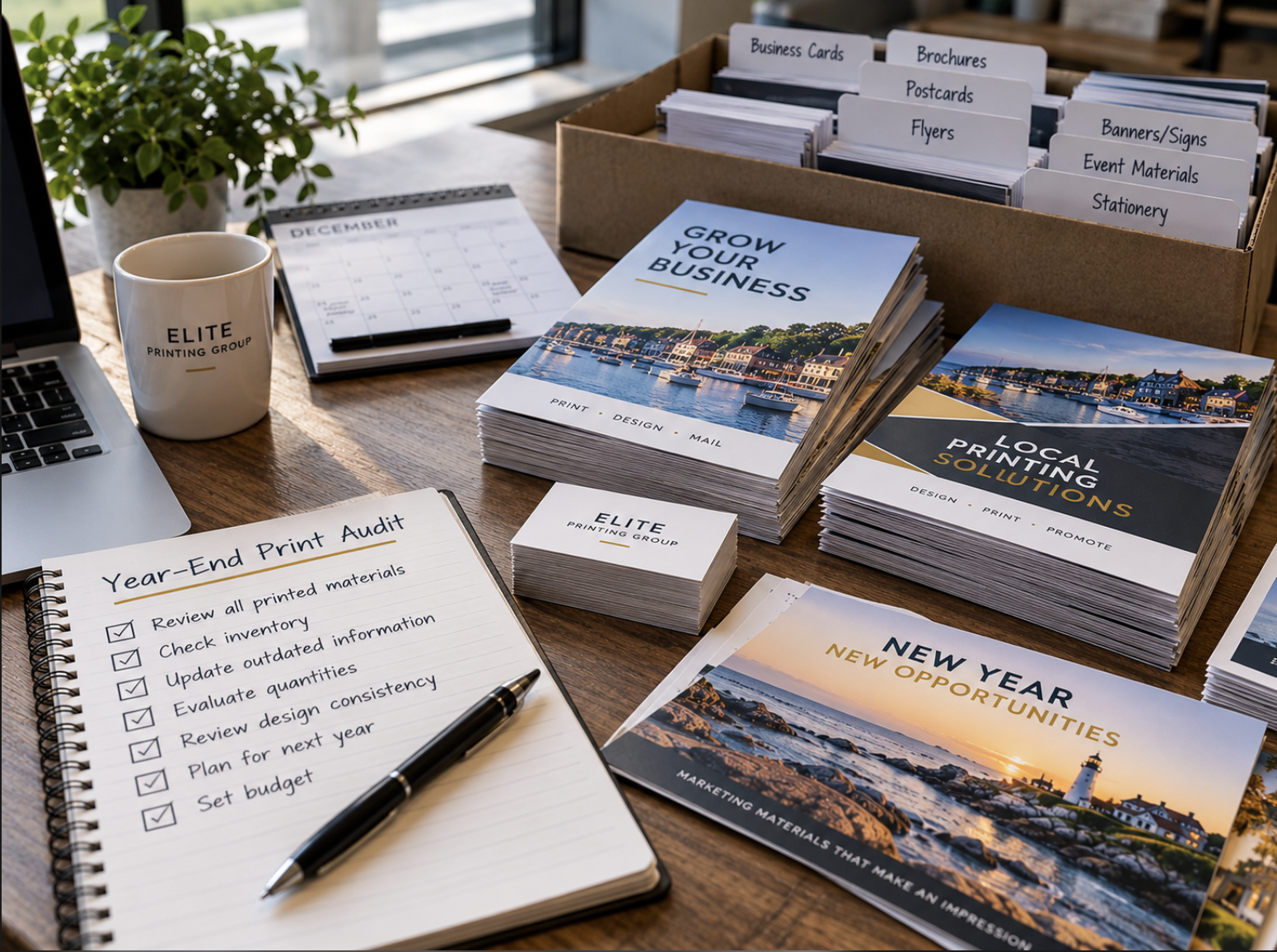
As the year draws to a close, many businesses take time to review operations, budgets, and marketing plans for the months ahead. A year-end print audit offers a practical way to evaluate the printed materials your business relies on, identify what is still useful, and plan more organized printing for the new year.
Printed marketing materials often accumulate quietly. Business cards are reordered, brochures are restocked, and event signage is produced as needs arise. Over time, branding can drift, contact details can change, and inventory can become difficult to track.
A structured review helps prevent those issues from compounding. Rather than waiting until a project deadline reveals an outdated logo or a shortage of brochures, a year-end audit gives your team an opportunity to address these details deliberately.
A year-end print audit is a practical review of your business's printed materials, inventory, branding, and ordering process — not a one-time purchase, but a habit that supports more organized commercial printing throughout the year.
Whether your business prints a few core materials each year or manages recurring campaigns across multiple locations, the following checklist can help you review what you have and plan more effectively for what comes next.
1. Inventory Your Current Printed Materials
Begin by gathering the printed materials your business currently uses.
This may include business cards, brochures, flyers, promotional postcards, direct mail pieces, event signage, presentation folders, letterhead, and other recurring products.
The goal is to understand what exists before deciding what to update, reorder, or retire.
List Each Product
Create a simple list of the printed products your business uses regularly.
For each item, note its intended purpose and where it is typically distributed or displayed.
Estimate Remaining Quantities
Where practical, estimate how much of each material remains in storage or at business locations.
This helps identify which products are running low and which have accumulated beyond what the business can reasonably use.
Note Where Materials Are Stored
If printed materials are kept in several locations, record where each item is stored.
This can help prevent duplicate orders and make it easier for employees to locate what they need.
2. Review Branding and Design Accuracy
Printed materials should reflect your business's current branding.
Over the course of a year, logos, color references, taglines, and visual styles can drift as different employees or designers create new pieces.
A year-end review is a practical time to confirm that your printed materials still represent the business accurately.
Check Logos and Colors
Verify that each printed product uses the current, approved version of your company logo and brand colors.
Set aside any materials that use outdated artwork so they are not reordered by mistake.
Review Typography
Confirm that headings, body text, and other typography follow a consistent style across related materials.
For more detailed guidance, read our article on Typography Tips for Printed Materials.
Confirm Visual Consistency
Business cards, brochures, postcards, and signage do not need to look identical, but they should feel connected to the same organization.
For additional guidance, explore How to Keep Your Brand Consistent Across Printed Materials.
3. Verify Contact Information and Business Details
Accurate contact information is one of the most important functions of printed marketing materials.
A business card with an old phone number or a brochure listing a discontinued service can create confusion and undermine an otherwise professional presentation.
Review Phone Numbers and Email Addresses
Check that all phone numbers, email addresses, and employee names listed on printed materials are current.
Confirm Physical Addresses
If your business has relocated or changed its service area, verify that printed materials reflect the correct address.
Check Website URLs
Confirm that website addresses and any QR codes direct recipients to current, functional pages.
Test QR codes with a smartphone and verify that linked pages work on mobile devices.
Review Service Descriptions
If your business has added, renamed, or discontinued services, update printed materials that no longer reflect the current offerings.
4. Identify Outdated or Unused Materials
Not every printed product remains useful indefinitely.
Materials tied to a specific event, a limited-time promotion, or an expired offer may no longer be appropriate to distribute.
Set Aside Event-Specific Materials
Flyers, postcards, or signage promoting a past event should be retired rather than distributed after the event has ended.
Review Promotional Pieces
If a promotion has expired, confirm that the related printed materials are no longer in circulation.
Evaluate Excess Inventory
If large quantities of a material remain unused, consider whether future orders of that product should be adjusted.
For broader guidance on estimating quantities, read How Many Printed Materials Should Your Business Order?.
5. Review Your Printing Budget and Expenses
A year-end audit is also an opportunity to review what your business spent on printing over the past year.
Understanding past expenses can help inform a more practical budget for the months ahead.
Summarize Printing Costs
Where records are available, review the total amount spent on printed materials, design preparation, mailing, and related costs.
Identify Recurring Expenses
Note which products were ordered repeatedly throughout the year and which were one-time purchases.
Plan for the Coming Year
Use the review to anticipate upcoming needs, including seasonal promotions, events, and any planned rebrands or service updates.
For a broader planning framework, explore A Practical Print Marketing Plan for the New Year.
6. Evaluate Your Ordering Process
How your business orders printed materials can be as important as what it orders.
A disorganized process can lead to last-minute orders, inconsistent artwork, and unnecessary expense.
Review Who Places Orders
Identify which employees or departments are responsible for ordering printed materials and whether the process is clearly defined.
Check Artwork Management
Confirm that current, approved artwork is stored in a location accessible to the people who place orders.
Archive outdated files to reduce the risk of accidental reuse.
Consider Centralized Ordering
If your business operates across multiple locations or departments, a more centralized ordering approach may help maintain consistent standards.
Elite Printing Group offers Branded Online Portals for businesses seeking more organized print ordering.
7. Plan for Upcoming Projects
After reviewing existing materials, look ahead to the printing projects your business anticipates in the new year.
List Scheduled Events and Promotions
Note trade shows, community events, seasonal promotions, and other activities that may require printed materials.
Anticipate Rebrands or Updates
If your business is planning a rebrand, a relocation, or a change in services, account for the printing that update will require.
Build in Production Lead Time
Production and delivery schedules vary by project, so confirm appropriate timing with your printing provider rather than assuming a fixed turnaround.
Year-End Print Audit Checklist
Use this checklist to guide your year-end review.
Inventory
- List all printed materials your business currently uses.
- Estimate remaining quantities of each product.
- Note where materials are stored.
- Identify materials that are running low.
- Identify materials with excess inventory.
Branding and Accuracy
- Confirm all materials use the current logo and brand colors.
- Review typography for consistency across materials.
- Verify phone numbers, email addresses, and physical addresses.
- Confirm website URLs and QR codes are current and functional.
- Update service descriptions that no longer reflect current offerings.
- Set aside materials with outdated branding or contact details.
Outdated Materials
- Retire materials tied to past events or expired promotions.
- Remove outdated materials from circulation.
- Adjust future order quantities based on unused inventory.
Budget and Process
- Review printing expenses from the past year.
- Identify recurring and one-time printing costs.
- Confirm who is responsible for placing orders.
- Verify that approved artwork is accessible and archived properly.
- Consider whether a centralized ordering approach would help.
Planning Ahead
- List upcoming events, promotions, and campaigns.
- Anticipate any planned rebrands or service updates.
- Confirm production and delivery timing with your printing provider.
- Establish a practical printing budget for the new year.
Not every business needs to complete every item, but the checklist provides a flexible framework that can be adapted to your organization's size and printing needs.
A Year-End Review Supports a More Organized New Year
A year-end print audit is not about producing more printed materials. It is about understanding what you have, confirming that it still represents your business accurately, and planning future printing with greater intention.
By reviewing inventory, branding, contact details, expenses, and the ordering process together, businesses can begin the new year with a clearer picture of their printed marketing materials.
The most useful print audit is the one that turns a year's worth of accumulated materials into a practical plan for the year ahead.
Plan Your Printing With Elite Printing Group
Since 2006, Elite Printing Group has provided commercial printing, graphic design, and personalized service to businesses and organizations. Based in the Seacoast of New Hampshire, we serve customers throughout New England and offer nationwide shipping.
Whether you're refreshing business cards and brochures, planning a direct mail campaign, or evaluating your overall printing process, our team can help you discuss your needs and available options.
Explore our Small Format Printing Services, Large Format Printing Services, and Graphic Design Services, or Get a Quote to discuss your next project.