
Indoor vs. Outdoor Banners: How to Choose the Right Option
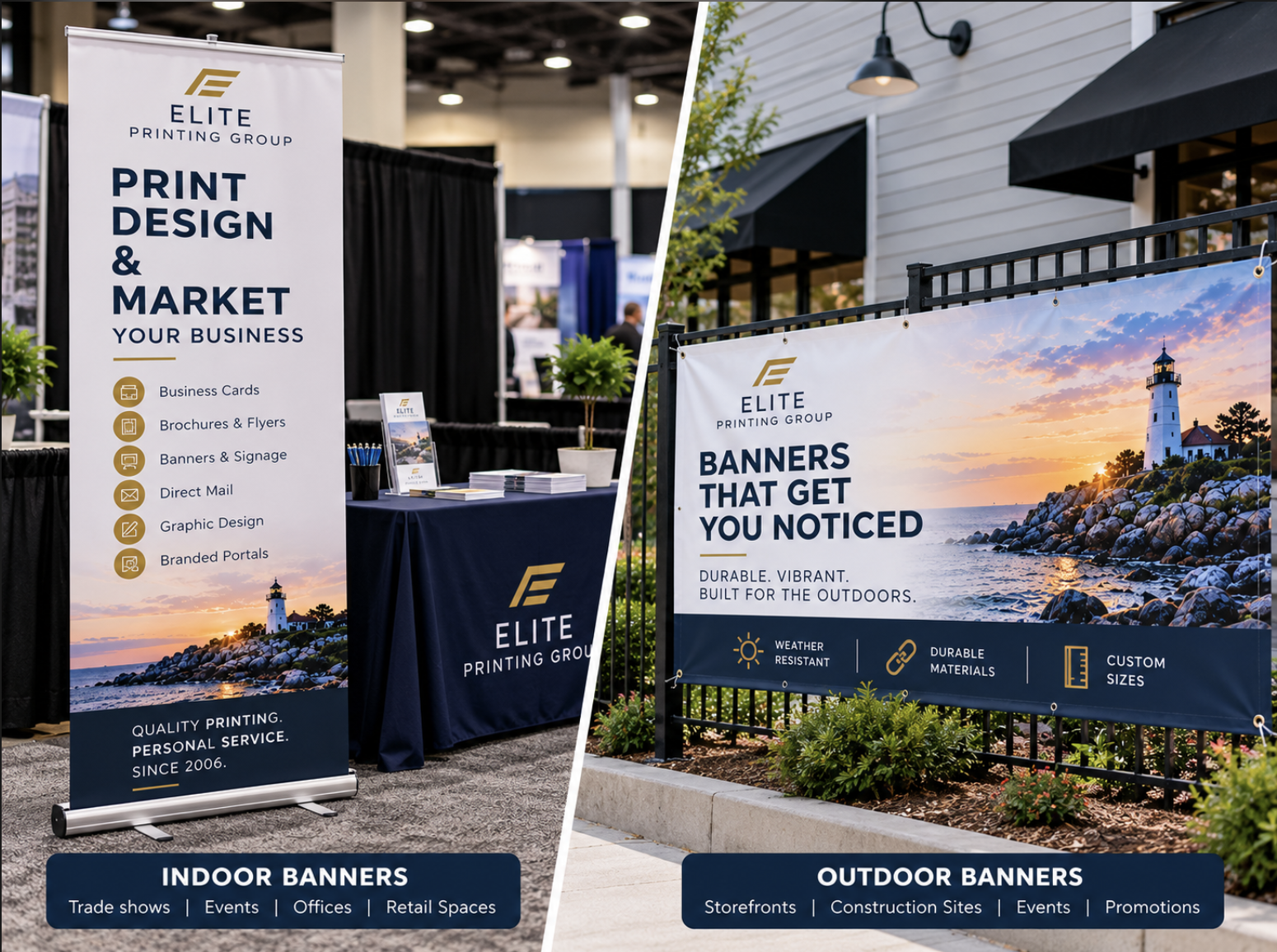
Banners are one of the most versatile forms of printed business signage. Whether you're promoting a community event, preparing for a trade show, announcing a seasonal promotion, or improving visibility at your business location, a professionally designed banner can communicate important information in a large, easily recognizable format.
However, not every banner is intended for the same environment.
A display used inside a conference center has different requirements from a banner installed outside a storefront. Indoor displays may prioritize appearance, portability, and convenient setup, while outdoor banners need to account for weather exposure, mounting conditions, and the surrounding environment.
Choosing the wrong material, dimensions, or installation method can create unnecessary complications, particularly when a banner must be displayed for an extended period or in challenging conditions.
The best banner for your business depends on where it will be displayed, how long it will be used, and what you need people to understand when they see it.
This guide explains the main differences between indoor and outdoor banners, the materials and design considerations involved, and the questions to ask before ordering your next large-format printing project.
1. What's the Difference Between Indoor and Outdoor Banners?
The most important distinction between indoor and outdoor banners is the environment in which they are intended to be displayed.
Indoor banners are generally protected from rain, significant wind, and other outdoor conditions. As a result, their design and material requirements often focus on presentation, available space, portability, and viewing distance.
Outdoor banners may be exposed to sunlight, moisture, changing temperatures, and wind. These environmental factors can influence material selection, finishing, mounting, and expected performance.
However, the distinction isn't always absolute.
A banner displayed beneath a covered outdoor pavilion may experience different conditions from one attached to an exposed fence. Similarly, a banner installed inside a busy commercial space may require more durable handling characteristics than a display used for a single presentation.
Before selecting a product, consider the actual conditions rather than relying only on the labels "indoor" and "outdoor."
Indoor vs. Outdoor Banner Comparison
| Consideration | Indoor Banners | Outdoor Banners |
|---|---|---|
| Primary environment | Protected interior spaces | Exposed or partially exposed locations |
| Common applications | Trade shows, conferences, lobbies, events | Storefronts, festivals, promotions, outdoor events |
| Main priorities | Appearance, readability, portability | Environmental suitability, visibility, secure mounting |
| Weather exposure | Usually minimal | May include rain, wind, sun, and temperature changes |
| Viewing distance | Often close to medium range | Can involve greater distances |
| Installation | Stands, approved hanging systems, or displays | Site-appropriate mounting and secure attachment |
| Material considerations | Presentation and handling | Exposure, duration, and installation requirements |
These are general comparisons. Actual product characteristics depend on the banner material, construction, finishing, and intended application.
2. When Indoor Banners Are the Better Choice
Indoor banners are commonly used in environments where businesses want to present information clearly without dealing with significant outdoor weather exposure.
They can help identify a business, introduce a service, promote an event, or reinforce branding within a controlled space.
Because indoor viewers may stand relatively close to the display, these banners can often accommodate more detailed information than outdoor signage intended to be read from a distance.
However, readability should still take priority over unnecessary text.
Trade Shows and Business Conferences
Trade shows and conferences bring together businesses, prospective customers, and industry professionals in shared exhibition spaces.
A banner can help attendees recognize your company's booth and understand what you offer before starting a conversation.
For example, a business attending a regional trade show in New Hampshire might use a display featuring its logo, primary service category, and a concise headline.
A supporting message or QR code may provide a convenient next step for visitors who want additional information.
Before preparing the artwork, confirm the exhibitor's space dimensions and the venue's display rules.
Corporate Events and Presentations
Indoor banners can also support company meetings, conferences, networking events, and presentations.
They may be used to identify a registration area, reinforce event branding, or provide a professional background for a particular part of the venue.
In these environments, a clean design with recognizable branding can be more effective than a banner crowded with promotional messages.
Retail Spaces and Business Lobbies
Businesses may use indoor displays to highlight services, announce promotions, or communicate information to visitors.
A banner located near an entrance or reception area can provide a visual introduction to the organization.
However, the design should fit the surrounding space and avoid obstructing walkways, entrances, or important building information.
The most appropriate display depends on the available room, intended audience, and how frequently the messaging will change.
3. Common Indoor Banner Formats and Display Options
Several types of display systems are commonly associated with indoor banner applications.
The appropriate choice depends on how the banner will be used and whether it needs to be transported, moved, or stored between events.
Retractable Banner Displays
Retractable banners are commonly used for trade shows, conferences, and other temporary indoor displays.
These systems typically allow a printed graphic to extend from a base and retract into the unit for storage.
They can be convenient for businesses that attend multiple events because portability and repeat setup are important parts of their intended design.
However, different systems have different dimensions, stability characteristics, and graphic requirements.
The availability of a specific retractable display system should be confirmed before planning the artwork.
Hanging Banners
Hanging banners can provide visibility within larger indoor spaces.
They may be useful for identifying an exhibitor area, displaying event branding, or helping attendees locate a particular section of a venue.
Before selecting a hanging format, confirm whether the location allows suspended displays and what installation requirements apply.
Some venues restrict overhead signage or require approved installation procedures.
Mounted Graphics and Other Displays
Depending on the project, a mounted sign or another large-format display may be more appropriate than a flexible banner.
A more rigid presentation can be useful when the graphic is intended for a particular wall, stand, or designated display area.
The best format depends on the location, expected duration, handling requirements, and available mounting options.
These products should be evaluated as alternatives rather than assuming one banner style is suitable for every interior space.
4. What Makes Outdoor Banners Different?
Outdoor banners require additional planning because their surroundings can change throughout the day and across the seasons.
A banner installed outdoors may experience direct sunlight, rain, wind, moisture, temperature changes, and repeated movement.
These conditions can influence both the printed material and the hardware used to display it.
For businesses in New Hampshire and throughout New England, seasonal weather is a particularly important consideration.
A banner used for a summer community event may experience different conditions from one displayed outside a business during colder months.
Weather Exposure
Rain and moisture can affect materials that aren't intended for outdoor use.
Sunlight and environmental exposure may also influence how printed graphics appear over time.
The extent of these effects depends on the material, inks, finishing, and duration of exposure.
Avoid assuming that every banner marketed for outdoor use will perform identically in all weather conditions.
Wind and Installation
Wind introduces significant considerations for outdoor banners.
A large banner can experience substantial force when exposed to moving air, particularly when attached to a fence, wall, or other structure.
Secure installation is therefore essential.
The banner, attachment hardware, mounting surface, and surrounding environment all need to be considered.
Do not assume that adding grommets or selecting a particular material automatically makes an outdoor installation safe.
Expected Display Duration
A banner intended for a one-day community event may require a different approach from signage expected to remain outdoors for several weeks or months.
Discuss the expected duration and environmental exposure with your printing provider before selecting materials.
This can help establish appropriate expectations and identify any special considerations.
5. Understanding Common Outdoor Banner Materials
Banner materials vary in their composition, thickness, flexibility, surface finish, and intended applications.
Two categories commonly discussed in outdoor banner printing are solid vinyl-style banner materials and perforated mesh materials.
However, the suitability of either option depends on the actual product and installation conditions.
Solid Banner Materials
Solid flexible banner materials are commonly used for promotional signage and event displays.
Depending on the construction and printing process, these materials may provide a suitable surface for large graphics, text, and colorful promotional designs.
They are often considered when a relatively continuous printed surface is desired.
However, a solid banner can also present a substantial surface to the wind, making the installation environment an important consideration.
Mesh Banner Materials
Mesh banners use a perforated structure that allows some airflow through the material.
They may be considered for certain outdoor applications where wind exposure is a concern.
However, mesh does not eliminate wind loads or guarantee safe installation.
The performance of a mesh banner depends on its construction, dimensions, mounting method, and the surrounding conditions.
Some designs may also require adjustments because the perforated surface can influence the appearance of smaller text and fine details.
For outdoor applications with meaningful wind exposure, appropriate installation planning and professional guidance are important.
Other Material Considerations
The best choice may also depend on opacity, flexibility, weight, print appearance, and available finishing options.
Material availability varies by printing provider, so confirm specific offerings and requirements before finalizing your order.
Elite Printing Group's Large Format Printing Services provide a starting point for discussing banner and promotional display needs.
6. Banner Finishing and Mounting Options
A banner's design and material are only part of the finished product.
Finishing and mounting also influence how it can be displayed.
Depending on the application, certain banner products may involve hems, reinforced edges, grommets, pole pockets, or other finishing details.
These features serve different purposes and should be selected based on the intended display system.
Grommets
Grommets are reinforced openings that may be incorporated into certain flexible banners to accommodate attachment methods.
Their placement and spacing depend on the banner dimensions and installation requirements.
They should not be treated as a guarantee that a banner can withstand a particular wind condition.
Reinforced Edges and Hems
Some banners use folded or reinforced edges to support their intended construction.
The appropriate finishing method depends on the material, dimensions, and planned use.
Pole Pockets
Certain banner displays use pockets designed to accommodate poles or compatible support systems.
These may be appropriate for selected hanging or display applications, depending on the installation.
Mounting Safety
Before installing a banner, verify that the mounting method is appropriate for the banner's size, weight, expected loads, and supporting structure.
Follow venue rules, property requirements, applicable regulations, and manufacturer instructions.
Where necessary, obtain guidance from qualified installation professionals.
A printing provider may supply the printed graphic without providing on-site installation, so those responsibilities should be clarified separately.
7. Design Banners for Their Viewing Distance
One of the biggest mistakes businesses make when designing banners is treating them like oversized brochures.
A design that looks attractive on a computer screen may become difficult to understand when enlarged and viewed from a distance.
Effective banner design starts by considering where people will stand, how much time they have to read the message, and what information matters most.
Keep Outdoor Messaging Short
Outdoor banners are often viewed by pedestrians or passing motorists.
In these situations, the available reading time may be limited.
A business name, concise headline, and clear identifying information may be more effective than a detailed list of services.
For example, a banner announcing a business event might prioritize the event name, date, and location.
Supporting details can be provided through other materials or an appropriate online destination.
Use Larger, Readable Typography
Text should be sized according to the intended viewing distance.
A headline on a banner displayed across a large outdoor area needs to be substantially more prominent than text on a display intended for close viewing.
Avoid decorative fonts and excessively thin lettering for essential information.
Maintain Strong Contrast
Clear contrast between text and background helps important information remain visible.
Be cautious when placing lettering over detailed photography or complex patterns.
A simple background often makes the primary message easier to recognize.
Use Visual Hierarchy
The most important information should be immediately apparent.
Supporting details can appear in a secondary position, but they shouldn't compete with the main headline.
For both indoor and outdoor banners, a clear hierarchy helps readers understand the message without unnecessary effort.
Elite Printing Group also offers Graphic Design Services for businesses preparing professional artwork.
8. How Much Information Should an Indoor Banner Include?
Indoor banners often allow for more detailed messaging because viewers may approach the display more closely.
However, that doesn't mean they should be filled with paragraphs.
A trade show banner, for example, might include a short headline, a brief service description, and a clear call to action.
Additional details can be provided through brochures, business cards, or conversations with company representatives.
A useful indoor banner generally answers three questions:
- Who is the business or organization?
- What is the primary message or offering?
- What should interested viewers do next?
A website address, QR code, or other relevant contact method can provide a practical next step when appropriate.
If using a QR code, make sure it's large enough to scan from the intended distance and clearly explain where it leads.
Test the code under realistic viewing conditions before printing.
Avoid placing critical information in areas that may be concealed by display hardware, furniture, or other elements of the environment.
9. Consider Portability, Storage, and Reuse
For businesses that participate in multiple events, portability can be an important factor in banner selection.
A display that's convenient for a single event may become cumbersome if employees need to transport and set it up regularly.
Before choosing a format, think about how the banner will be handled throughout its useful life.
Transport
Consider whether the display needs to fit inside a vehicle or be transported with other event materials.
A compact system may be more convenient than a larger installation requiring special handling.
Setup and Breakdown
Determine who will assemble or install the display and whether the process is practical for the intended venue.
Always follow the requirements of the selected display system.
Storage
When not in use, banners should be stored according to the material and manufacturer's guidance.
Improper folding, rolling, exposure to moisture, or excessive pressure can affect certain printed materials.
Reusable Messaging
If a banner will be used at several events, evergreen branding may provide greater flexibility than messaging tied to a particular date.
For example, a banner displaying the company name and primary service category may remain useful for multiple trade shows.
A banner promoting a single seasonal event may have a much shorter useful life.
Choosing the appropriate message can be just as important as choosing the material.
10. Account for the Display Location and Venue Rules
Before ordering a banner, confirm the requirements of the location where it will be displayed.
A trade show organizer may have specific rules regarding booth dimensions, banner height, hanging signs, and approved display systems.
Outdoor venues may also have restrictions involving temporary signage, attachment points, public access, and installation methods.
Commercial property owners or municipalities may regulate where banners can be displayed and whether permits are required.
These requirements can vary by location.
Questions to Ask the Venue or Property Owner
- Is banner signage permitted in the intended location?
- Are there limits on dimensions or placement?
- What mounting methods are allowed?
- Are hanging displays or overhead installations restricted?
- Are there requirements related to pedestrian access or visibility?
- Does the venue require professional installation?
- Are there local permits or approvals that must be obtained?
Confirming these details before production helps avoid ordering a banner that cannot be displayed as planned.
It also allows the artwork and dimensions to be selected with the actual space in mind.
11. What to Include When Requesting a Banner Printing Quote
Providing clear project details can help your printing provider discuss appropriate materials and available options.
You don't need to know every technical specification in advance, but describing the intended use is important.
When requesting a quote, consider sharing:
- Banner type: Indoor, outdoor, or a display that may be used in both environments.
- Intended location: Trade show booth, lobby, storefront, fence, community event, or another setting.
- Approximate dimensions: The desired finished width and height.
- Quantity: How many banners are needed.
- Display duration: Whether the banner is intended for one event or repeated use.
- Environmental exposure: Expected sunlight, rain, wind, and other relevant conditions.
- Mounting requirements: How the banner is expected to be displayed.
- Material preferences: Any known appearance or performance requirements.
- Artwork status: Whether print-ready files are available or design assistance is needed.
- Deadline: When the finished banner must be available.
- Delivery requirements: Pickup or shipping preferences.
If you're uncertain about the best material or format, explain the situation rather than selecting a product based only on its name.
For example, saying that a banner will be displayed outdoors on an exposed fence for several weeks provides more useful context than simply requesting an "outdoor banner."
The printing provider can then discuss relevant options, while any installation or structural considerations can be evaluated by the appropriate professionals.
Indoor vs. Outdoor Banner Planning Checklist
Before finalizing your next banner order, review the following:
- Confirm whether the banner will be displayed indoors, outdoors, or in a partially protected area.
- Identify the intended viewing distance.
- Measure the available display space.
- Review venue or property restrictions.
- Choose messaging appropriate for the audience and environment.
- Confirm that text is large enough to read.
- Use strong contrast and recognizable branding.
- Discuss suitable material and finishing options.
- Clarify mounting and installation responsibilities.
- Consider whether the banner will be reused.
- Review transportation and storage requirements.
- Prepare artwork according to the printing provider's specifications.
- Confirm production and delivery timing.
- Review and approve the final design before printing.
Not every project requires the same considerations, but this checklist provides a practical starting point for both indoor and outdoor applications.
Choosing the Right Banner for Your Business
Indoor and outdoor banners can both be effective marketing tools, but they are designed around different practical needs.
Indoor displays often emphasize appearance, portability, and presentation within a controlled environment. Outdoor banners require additional attention to weather exposure, material selection, mounting conditions, and safe installation.
In either setting, the design should communicate a clear message that viewers can understand at the intended distance.
Businesses should also consider how often the banner will be used and whether the content will remain relevant for future events.
The right banner isn't necessarily the largest, most durable, or most expensive option. It's the one that fits the intended environment and communication goal.
By confirming the location, dimensions, design requirements, and installation considerations before ordering, businesses can make more informed decisions about their large-format printing projects.
Explore Banner Printing With Elite Printing Group
Since 2006, Elite Printing Group has provided commercial printing, graphic design, and personalized service to businesses and organizations. Based in the Seacoast of New Hampshire, we serve customers throughout New England and offer nationwide shipping.
Whether you're preparing an indoor trade show display, promotional event banner, storefront graphic, or another large-format printing project, our team can help you discuss your needs and explore suitable printing options.
Learn more about our Large Format Printing Services, explore our Graphic Design Services, or Get a Quote to discuss your next banner project.
Need large format banners for your business?
From indoor roll-up trade show displays to weather-ready outdoor banners, Elite Printing Group helps you choose the right materials and design for your space.
Explore Large Format Printing