
The Direct Mail Checklist Every Business Should Follow
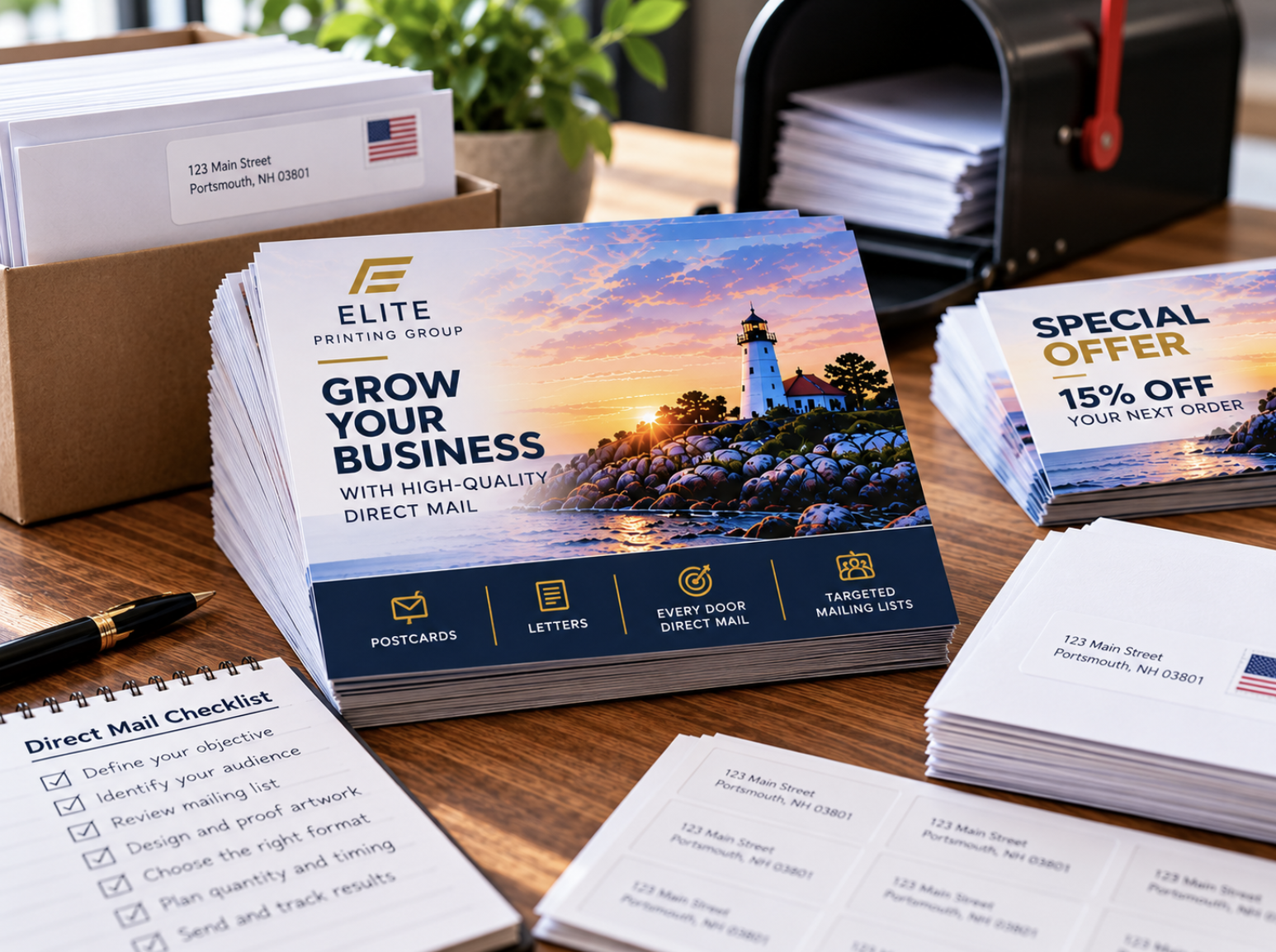
Direct mail gives businesses a tangible way to reach customers and prospective buyers. Whether you're announcing a grand opening, promoting a seasonal offer, introducing a new service, or reconnecting with existing customers, a professionally printed mailing can communicate your message directly through the mailbox.
Unlike a digital advertisement that appears briefly on a screen, a printed postcard, letter, or other mail piece can be physically handled, reviewed, and kept for later reference. However, the success of a direct mail campaign depends on more than attractive artwork and professional printing.
A well-organized mailing requires clear objectives, an appropriate audience, accurate information, thoughtful design, and realistic production and distribution planning.
Without those elements, even a visually appealing postcard can struggle to communicate its purpose.
For businesses in New Hampshire, throughout New England, and beyond, direct mail can complement websites, digital advertising, and other marketing activities by creating another opportunity to connect with relevant audiences.
Whether you're planning your first campaign or reviewing an established mailing strategy, this checklist will help you understand the key decisions involved in creating a more organized direct mail campaign.
1. Begin With One Clear Campaign Objective
Before selecting a postcard size, preparing artwork, or identifying a mailing audience, determine what you want your campaign to accomplish.
A direct mail campaign promoting a seasonal retail sale has a different purpose from one introducing a professional service or inviting customers to an event.
When the objective is clear, it becomes easier to develop the message, select the audience, and determine what response you're looking for.
Common direct mail objectives include:
- Generating customer inquiries: Encouraging recipients to contact your business or request an estimate.
- Promoting a specific service: Introducing an offering to people who may find it relevant.
- Increasing store visits: Inviting customers to visit a physical location.
- Announcing events: Sharing information about grand openings, fundraisers, or other scheduled activities.
- Reconnecting with existing customers: Communicating business updates, relevant services, or appreciation messages.
- Promoting seasonal offers: Highlighting a time-sensitive promotion with clearly stated conditions.
Trying to accomplish all these goals within one mailing can make the message difficult to understand.
For example, a postcard asking someone to book an appointment, follow several social media accounts, visit multiple websites, and subscribe to a newsletter may create unnecessary confusion.
Instead, establish one primary objective and make it the central focus of the campaign.
Supporting information can provide context, but the next step should remain clear.
2. Identify the Audience You Want to Reach
A direct mail campaign should begin with an understanding of the people most likely to find the message relevant.
Sending materials to a large audience isn't automatically more useful than reaching a smaller, more appropriate group.
The best audience depends on the product or service being promoted, the geographic area involved, and the campaign's overall purpose.
For example, a local home service business may want to reach households within its operating area.
A professional services company might focus on a particular business audience, while a retailer may want to communicate with existing customers about an upcoming event.
Consider Geographic Relevance
For businesses serving a defined local area, geography can be an important starting point.
A company operating in the Seacoast region of New Hampshire may want its mailing to reach locations where it can realistically serve customers.
Expanding the distribution area without considering service availability can lead to unnecessary spending.
Distinguish Between New and Existing Customers
Existing customers may already be familiar with your business, allowing the message to focus on a relevant update or offer.
Prospective customers may require a clearer introduction explaining who you are and what you provide.
These audiences may benefit from different wording, even when the same general service is being promoted.
Use Appropriate Mailing Data
Mailing information should be obtained, maintained, and used responsibly.
Businesses should follow applicable privacy and marketing requirements and confirm that their mailing data is appropriate for the intended campaign.
A well-defined audience creates a stronger foundation for the messaging and distribution strategy.
3. Review Mailing List Quality and Accuracy
The quality of a mailing list can influence whether printed pieces reach the intended destinations.
Outdated addresses, duplicate records, incorrect formatting, or incomplete information can create unnecessary problems during mailing preparation.
For businesses using an existing customer list, review the information before beginning production.
Check whether addresses are current, whether the intended recipients are appropriate for the campaign, and whether duplicate records need attention.
Common Mailing List Issues
Potential concerns include:
- Outdated customer addresses.
- Duplicate records.
- Missing address components.
- Inconsistent formatting.
- Incorrect geographic targeting.
- Records that should no longer be used.
- Incomplete or inaccurate recipient information.
Address verification and preparation requirements depend on the mailing method and applicable postal standards.
Some campaigns may involve address-processing procedures or list preparation services, but the exact approach should be confirmed with the appropriate mailing provider.
The purpose is to reduce avoidable mailing issues and make better use of the campaign budget.
4. Select the Right Direct Mail Format
Direct mail can involve several types of printed materials, and the appropriate format depends on the amount of information you need to communicate.
A promotional postcard may work well for a concise announcement, while a more detailed letter or multi-piece mailing may be appropriate when additional explanation is necessary.
Promotional Postcards
Postcards are commonly used for seasonal offers, customer announcements, event invitations, and other focused marketing messages.
They provide space for a headline, supporting information, imagery, and a clear call to action.
Because the available space is limited, the design should prioritize the most important details.
Letters and Envelopes
A letter may be appropriate when a business needs to communicate more detailed information or create a more personal presentation.
The format should reflect the audience, purpose, and amount of information being shared.
Folded or Multi-Panel Mailers
Some campaigns may benefit from folded printed materials when additional content is necessary.
However, folding, dimensions, weight, and other production details can affect postal eligibility and preparation requirements.
Consider Postal Requirements Early
Different mailing formats may have different rules involving dimensions, thickness, addressing, weight, and machinability.
Before finalizing artwork, confirm the requirements for the selected mailing service.
Choosing the right format early can help prevent design revisions later.
Elite Printing Group offers Direct Mail Services for businesses planning printed mailing campaigns.
5. Write a Message That Communicates Value Quickly
A direct mail recipient should be able to understand the main point of the message without searching through a lengthy block of text.
This is particularly important for postcards and promotional mailers, where the available space may be limited.
An effective message generally explains what is being offered, why it may matter to the recipient, and what action to take next.
Lead With a Clear Headline
The headline should communicate the central purpose of the mailing.
For example, a postcard announcing a grand opening should make that event immediately recognizable.
A service promotion should clearly identify the offering rather than relying on vague wording.
Explain the Relevant Benefit
After establishing the main message, provide enough context for the recipient to understand its value.
A business promoting an appointment-based service might explain what the appointment is intended to address.
A retailer announcing a seasonal offer should communicate the relevant details and conditions.
Avoid exaggerated claims or promises that the business cannot support.
Keep Supporting Copy Focused
Direct mail doesn't need to communicate every aspect of your business.
Include information that supports the primary campaign objective and remove details that introduce unnecessary complexity.
A concise, well-organized message is often easier to understand than a crowded design containing several unrelated promotions.
6. Include One Clear Call to Action
A call to action, or CTA, tells recipients what to do after reading the mailing.
It connects the marketing message to a specific next step.
For a local service business, that might mean requesting an estimate. For an event organizer, it could mean registering for an upcoming event.
The best CTA depends on the objective established at the beginning of the campaign.
Examples include:
- Request a Quote.
- Schedule a Consultation.
- Explore Our Services.
- View Event Details.
- Visit Our Store.
- Register for the Event.
The wording should accurately describe what happens when the recipient responds.
Make the CTA Easy to Find
Use clear typography, sufficient contrast, and appropriate spacing to distinguish the primary action from surrounding text.
A CTA shouldn't be buried beneath several paragraphs or competing design elements.
Match the Destination to the Message
If a postcard encourages someone to learn about a specific service, the corresponding website link should ideally lead to relevant information.
Sending every recipient to a generic homepage can introduce additional steps.
When practical, use an appropriate service page or focused landing page that supports the printed message.
Avoid Unnecessary Competing Actions
Providing multiple contact methods can be useful, but the primary CTA should remain obvious.
For more detailed guidance, read our article on Creating an Effective Direct Mail Call to Action.
7. Design for Both Visual Appeal and Postal Requirements
Direct mail artwork needs to perform two functions: communicate a marketing message and meet the requirements of the selected mailing format.
A postcard might look attractive on a computer screen but still require changes if the address area, dimensions, or other postal details are unsuitable.
That's why mailing requirements should be considered before the final design is approved.
Establish the Correct Dimensions
Confirm the intended finished size and applicable mailing specifications before beginning the layout.
Different dimensions may affect the available postal service options.
Leave Appropriate Space for Addressing
Mail pieces may require designated areas for recipient addresses, postage, barcodes, or other postal information.
The exact requirements vary by format and service.
Don't place critical marketing content in areas that need to remain available for mailing information.
Use Print-Ready Artwork
Images, fonts, colors, and document dimensions should be prepared according to the printing provider's specifications.
For materials with edge-to-edge artwork, appropriate bleed may be necessary.
Keep essential text and logos within the recommended safe area.
Maintain Readability
Printed promotional materials should use clear typography and sufficient contrast.
Avoid overcrowding the design with small text, complex backgrounds, or excessive visual elements.
Businesses preparing artwork can explore Elite Printing Group's Graphic Design Services.
8. Use QR Codes and Website Links Thoughtfully
Direct mail can connect physical marketing with digital experiences.
A printed postcard may encourage recipients to visit a website, request information, schedule an appointment, or explore a service online.
QR codes can provide a convenient way to access these destinations from a smartphone.
However, they should be used intentionally.
Explain Where the QR Code Leads
An unlabeled QR code gives recipients little reason to scan it.
Include a short explanation such as "Scan to View Event Details" or "Scan to Explore Our Services."
The label should accurately reflect the destination.
Test Before Printing
Scan the QR code using a smartphone and verify that it opens the intended page.
Check that the destination is readable on mobile devices and that any necessary forms or links function correctly.
Provide an Alternative
Not every recipient will choose to scan a QR code.
When appropriate, include a short website address or another accessible way to obtain the same essential information.
Keep Destinations Current
If the printed mailing includes a time-sensitive promotion, confirm that the destination accurately reflects the offer and applicable dates.
A broken link or outdated page can undermine an otherwise professional campaign.
9. Estimate the Right Mailing Quantity
Direct mail quantities are closely connected to the selected audience and distribution strategy.
Unlike brochures that might be handed out at an event, direct mail pieces are generally prepared around a planned set of recipients or addresses.
The initial quantity should therefore reflect the intended mailing audience and any additional project requirements.
Avoid Assuming More Is Always Better
A larger mailing may reach more addresses, but that doesn't guarantee a better result.
Audience relevance, messaging, offer quality, and timing all influence the campaign experience.
A carefully selected audience may be more appropriate than expanding distribution without a clear reason.
Consider Total Project Cost
Printing costs can vary by quantity, dimensions, paper selection, and finishing requirements.
Mailing preparation and postage may also affect the overall budget.
Review the complete estimated campaign cost rather than focusing only on the printing price per piece.
Plan for Appropriate Extra Copies
If the business needs internal samples, review copies, or other additional materials, discuss those quantities during planning.
Avoid assuming that every mailing automatically requires the same percentage of extras.
For broader quantity-planning guidance, read How Many Printed Materials Should Your Business Order?.
10. Establish a Realistic Campaign Timeline
A direct mail campaign can involve several stages before recipients receive the printed material.
Depending on the project, these may include message development, artwork preparation, audience selection, file review, printing, addressing, mailing preparation, and postal processing.
Each stage should be considered when establishing the overall timeline.
Start With the Intended Arrival Window
If a campaign promotes an event or limited-time offer, determine when recipients should ideally receive the message.
Then work backward to establish appropriate planning milestones.
Account for Design and Approval
Artwork may require revisions or approval from several stakeholders.
Allow time to review important details before production.
Confirm Production Requirements
The printing schedule depends on the product, quantity, finishing, and other specifications.
Actual turnaround times should be confirmed with the printing provider.
Consider Postal Processing
Mail delivery timing varies based on the mailing service, postal operations, and other conditions.
Avoid assuming a guaranteed arrival date unless an applicable service explicitly provides one.
For time-sensitive promotions, build a reasonable buffer into the plan.
The goal is to ensure that recipients have a meaningful opportunity to respond while the message remains relevant.
11. Prepare a Way to Evaluate Campaign Responses
Businesses often want to understand whether a direct mail campaign generated inquiries, store visits, registrations, or other meaningful responses.
A clear campaign objective provides a starting point for deciding what to measure.
For example, a postcard encouraging customers to request an estimate could be evaluated by reviewing relevant inquiries.
An event invitation might be assessed through registrations or attendance.
Possible measurement methods include:
- Campaign-specific website destinations.
- QR codes linking to relevant pages.
- Promotional or redemption codes.
- Dedicated inquiry forms.
- Customer feedback about how they heard of the business.
- Other appropriate campaign response records.
These methods can provide useful information, but they don't capture every possible outcome.
Someone may see a mail piece, remember the business, and return later through a different marketing channel.
Because of this, direct mail results should be interpreted within the broader customer journey.
Don't Assume Every Response Is Directly Attributable
A customer may interact with several marketing channels before contacting the business.
Campaign-specific tools can help organize information, but attribution isn't always exact.
Review What You Can Learn
After the campaign, consider which messages generated interest, whether recipients encountered problems with the response process, and what could be improved.
The purpose of measurement is to support better future decisions rather than guarantee a particular return.
12. Review Your Mailing Before Production
The final approval stage is one of the most important parts of a direct mail campaign.
Even a minor error can become significant when repeated across an entire mailing.
Before production, review the content, artwork, destination information, and applicable mailing specifications.
Check the Marketing Message
Confirm that the headline, supporting copy, and call to action accurately communicate the campaign's purpose.
Verify Contact Information
Review phone numbers, website addresses, business locations, and other details recipients may use to respond.
Confirm Promotional Terms
If the campaign contains a discount, deadline, event date, or other offer, verify that the information is accurate and any necessary conditions are clearly stated.
Test Digital Destinations
Open website links and scan QR codes using real devices.
Ensure the linked pages are current and functional.
Review Production Specifications
Confirm the finished dimensions, artwork requirements, addressing considerations, quantities, and other details.
Approve the Final Exported Artwork
Inspect the final file intended for production rather than relying exclusively on the original design document.
A careful final review can help reduce avoidable errors before printing begins.
Common Direct Mail Campaign Mistakes to Avoid
Several recurring issues can make direct mail campaigns harder to execute or less useful to recipients.
Unclear campaign objectives: Without a specific goal, the mailing may contain competing messages and no obvious next step.
Poor audience selection: Sending the same message indiscriminately may create unnecessary expense and reduce relevance.
Outdated mailing data: Inaccurate addresses and duplicate records can complicate distribution.
Crowded artwork: Excessive text, low contrast, and competing graphics can make the message difficult to understand.
Weak calls to action: Vague wording may leave recipients unsure how to respond.
Ignoring postal specifications: Incorrect dimensions or addressing areas may require artwork revisions.
Broken QR codes or links: A recipient may be interested in the offer but unable to reach the intended destination.
Unrealistic timelines: Insufficient time for production and postal processing can create problems for campaigns with fixed dates.
Lack of follow-up planning: Businesses should be prepared to handle inquiries or responses generated by their campaigns.
Addressing these issues before production can help create a clearer and more organized mailing.
Your Essential Direct Mail Campaign Checklist
Use the following checklist when preparing your next direct mail project.
Campaign Strategy
- Define one primary campaign objective.
- Identify the intended audience.
- Confirm the geographic or customer segment being targeted.
- Determine the desired recipient action.
- Establish a practical campaign budget.
Mailing List and Distribution
- Review mailing data for accuracy and relevance.
- Identify duplicate or outdated records.
- Confirm the intended mailing method.
- Review applicable postal and privacy requirements.
- Establish the approximate mailing quantity.
Content and Design
- Write a clear headline.
- Explain the relevant benefit or offer.
- Include one prominent call to action.
- Use current business branding.
- Verify contact information and promotional details.
- Ensure the artwork meets production and mailing specifications.
- Review text readability and visual contrast.
Digital Follow-Up
- Confirm website links are correct.
- Test QR codes with a smartphone.
- Verify landing pages work on mobile devices.
- Ensure online information matches the printed message.
- Establish an appropriate process for handling responses.
Production and Review
- Confirm the final quantity and specifications.
- Review artwork and proofread all information.
- Approve the final production file.
- Confirm printing and mailing arrangements.
- Allow sufficient time for production and postal processing.
- Review available campaign results afterward.
Not every campaign requires every item on this checklist, but the overall process can help businesses identify important details before investing in printing and mailing.
A Well-Planned Direct Mail Campaign Starts Before Printing
Direct mail remains a practical way for businesses to communicate through a physical medium, but an organized campaign requires much more than selecting a postcard design.
The objective, audience, mailing data, message, format, production requirements, and response process all contribute to how the campaign is experienced.
When those elements are planned together, the printed piece can serve a clearer purpose and make it easier for recipients to understand the intended next step.
The most effective approach isn't necessarily the most elaborate.
Often, a focused message, relevant audience, professional design, and realistic timeline provide a stronger foundation than a complicated campaign with too many competing objectives.
Successful direct mail planning begins with knowing who you want to reach, what you want to communicate, and how recipients should respond.
Plan Your Next Direct Mail Campaign With Elite Printing Group
Since 2006, Elite Printing Group has provided commercial printing, graphic design, and direct mail services with personalized customer service. Based in the Seacoast of New Hampshire, we serve businesses throughout New England and offer nationwide shipping.
Whether you're preparing promotional postcards, customer announcements, event invitations, or another printed mailing, our team can help you discuss your printing requirements and explore options for your project.
Learn more about our Direct Mail Services, explore our Graphic Design Services, or Get a Quote to discuss your next campaign.