
Small Format vs. Large Format Printing: What's the Difference?
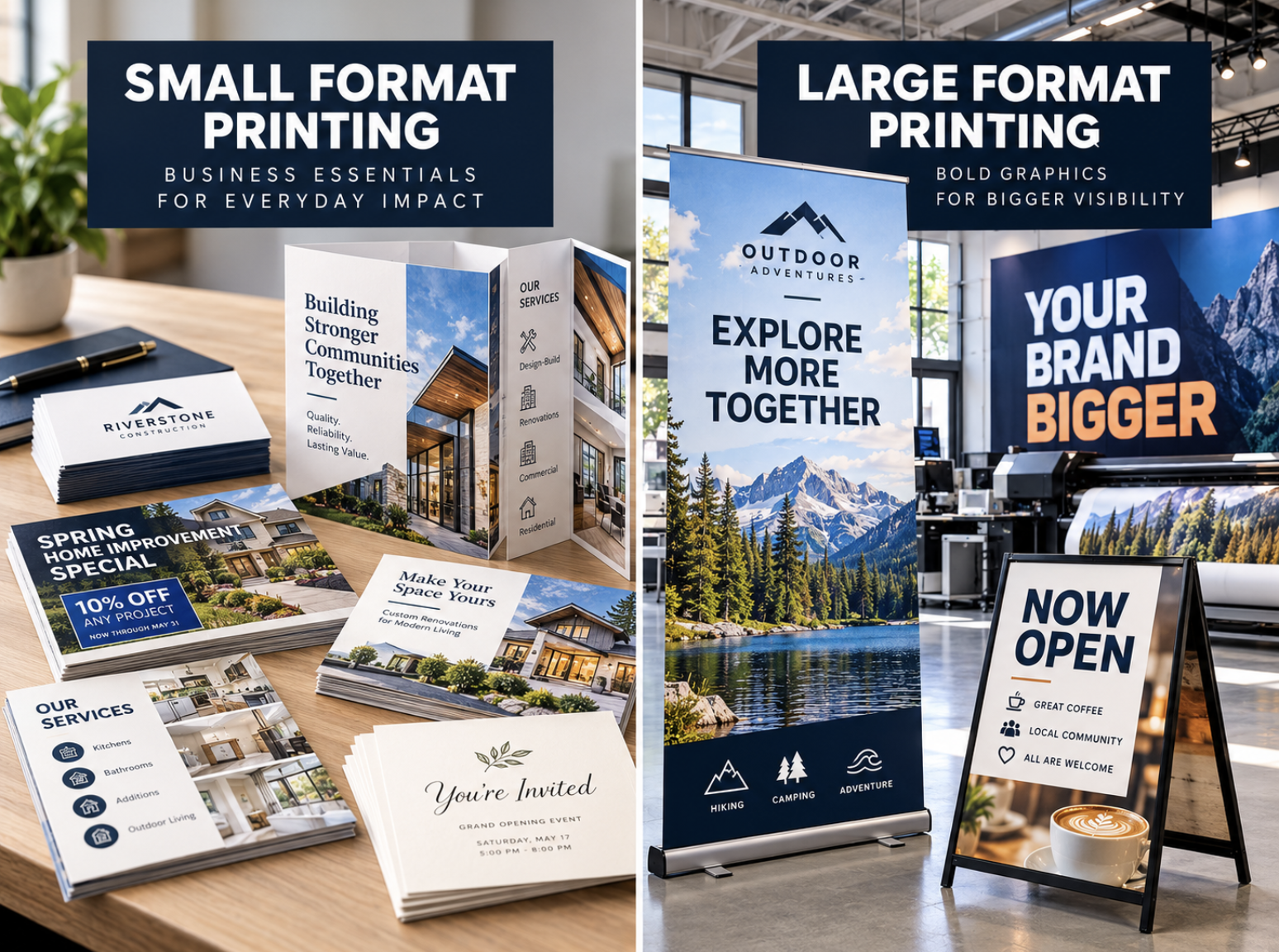
Commercial printing plays an important role in how businesses present themselves, promote their services, and communicate with customers. From a professionally designed business card handed out during a meeting to a large promotional banner displayed at a trade show, printed materials help businesses make an impression in a wide range of settings.
However, not every printing project requires the same equipment, materials, design approach, or production process. Two of the most common categories are small-format printing and large-format printing, each serving different purposes depending on the size, intended use, and viewing environment of the finished product.
Understanding the differences can help you select the right materials, prepare your artwork correctly, and make more informed decisions when requesting a commercial printing quote.
Whether you're producing business cards, brochures, posters, banners, or promotional signage, here's what you should know about these two types of commercial printing.
What Is Small-Format Printing?
Small-format printing generally refers to printed materials designed to be held, handled, distributed, or viewed at relatively close distances. These products are commonly used for everyday business communication, marketing campaigns, professional presentations, and customer interactions.
Unlike larger display graphics, small-format materials often contain detailed information that readers are expected to examine closely. This makes typography, image quality, paper selection, and finishing particularly important.
Common examples of small-format printing include:
- Business cards: Compact pieces that communicate essential contact information and reinforce a company's visual identity.
- Brochures: Folded or multi-page marketing materials that explain services, products, or organizational information.
- Flyers: Versatile promotional pieces used for announcements, special events, sales, and community outreach.
- Postcards: Printed marketing materials commonly used for customer communications, promotional campaigns, and direct mail.
- Invitations and announcements: Printed communications for business events, openings, celebrations, and special occasions.
- Presentation materials: Printed documents, handouts, and other collateral used during meetings or sales presentations.
- Marketing collateral: Various printed pieces that support advertising, brand awareness, and customer education.
Because customers often interact with these materials directly, their physical characteristics can contribute to the overall impression of a business.
For example, a substantial cardstock business card may communicate a different level of formality than a lightweight promotional flyer. A brochure printed on an appropriate coated stock may emphasize colorful photography, while an uncoated paper may be better suited to materials that require handwriting.
The right choice depends on the message, intended audience, and how the finished product will be used.
Businesses looking for professional business cards, brochures, flyers, postcards, and similar materials can explore Elite Printing Group's Small Format Printing Services.
What Is Large-Format Printing?
Large-format printing is used to produce oversized graphics and visual displays that extend beyond the dimensions of many conventional printed marketing materials.
These projects are commonly intended to attract attention, communicate information from a distance, improve visibility, or create a branded environment.
Large-format printing is frequently used for trade shows, business events, retail promotions, storefront displays, and other applications where a standard brochure or flyer would not provide sufficient visibility.
Common examples include:
- Banners: Large promotional graphics used for events, business announcements, advertising, and displays.
- Posters: Oversized printed visuals for promotions, informational displays, and event advertising.
- Business signage: Printed signs that help identify businesses, promote services, or communicate important information.
- Trade show graphics: Large display elements that establish brand recognition within an exhibition space.
- Event displays: Printed graphics used for conferences, fundraisers, community events, and promotional activities.
- Window graphics: Visual materials used to communicate messaging or branding on suitable glass surfaces.
- Promotional displays: Oversized graphics intended to draw attention to products, services, or special announcements.
Large-format projects often require different materials and finishing considerations than small-format printing.
For example, a banner intended for temporary indoor display may have different requirements from one expected to withstand outdoor conditions. Similarly, a poster mounted inside a business may use different materials than a sign intended for repeated installation and transport.
The design also needs to account for how people will encounter the material. A large banner might only be visible for a few seconds as someone passes by, while an informational poster may be viewed from a closer distance.
For projects involving banners, posters, signage, and other oversized graphics, learn more about Elite Printing Group's Large Format Printing Services.
Small-Format vs. Large-Format Printing: Key Differences
Although both categories involve producing physical printed materials, several important differences affect how projects should be designed and planned.
| Consideration | Small-Format Printing | Large-Format Printing |
|---|---|---|
| Typical products | Business cards, brochures, flyers, postcards | Banners, posters, signs, event displays |
| Primary purpose | Detailed communication and direct distribution | Visibility, promotion, and large-scale messaging |
| Viewing distance | Generally close range | Often medium or long range |
| Content approach | Can accommodate detailed information | Usually benefits from concise, high-impact messaging |
| Common materials | Paper, cardstock, coated and uncoated stocks | Banner materials, poster media, rigid substrates, and other display materials |
| Design priorities | Readability, detail, paper quality, and finishing | Visibility, contrast, scale, and placement |
| Distribution | Handouts, mailings, meetings, and customer interactions | Storefronts, trade shows, events, and physical displays |
These distinctions are useful starting points rather than strict rules. Some posters may be viewed closely, while certain smaller printed pieces may need to communicate quickly from a distance.
The best production approach ultimately depends on the specific project and its intended use.
How Design Requirements Differ Between Small and Large Formats
One of the most important differences between small-format and large-format printing is how the artwork should be designed.
Although businesses should maintain consistent branding across both, the layout, typography, image resolution, and amount of information can vary substantially.
Small-Format Design Prioritizes Detail and Readability
Small-format materials often give businesses room to provide explanations, product details, contact information, and supporting visuals.
A brochure, for example, may include a headline, several service descriptions, photographs, and a clear call to action. Because readers can hold the brochure and examine it closely, the design can accommodate more detailed content.
However, this doesn't mean every available space should be filled.
Strong typography, comfortable margins, organized sections, and appropriate white space are essential for maintaining readability.
The design should make it easy for readers to understand the message without feeling overwhelmed by excessive information.
Large-Format Design Prioritizes Visibility and Impact
Large-format graphics require a different approach because they are often viewed from farther away or encountered briefly.
A banner positioned across a trade show booth should communicate the company's identity and primary message quickly. A storefront sign needs to remain readable within its intended environment, while an event display should help visitors recognize important information without unnecessary effort.
For these applications, simple headlines, strong contrast, larger typography, and recognizable branding are especially valuable.
Trying to enlarge a detailed flyer into a large banner often produces a less effective result because the original layout wasn't designed for long-distance viewing.
A useful principle is to match the amount of information to the distance and time available for reading it.
The more quickly someone needs to understand the message, the more important visual simplicity becomes.
Image Resolution and Print File Preparation
Both small-format and large-format projects benefit from properly prepared artwork, but their technical requirements may differ.
For many small-format products viewed closely, high-resolution images are important for reproducing photographs, graphics, and fine details clearly. Approximately 300 pixels per inch at final print size is a common recommendation for many commercial printing applications, although the appropriate resolution depends on the project.
Large-format graphics can have different image resolution requirements because they may be viewed from greater distances.
A banner intended to be seen from across a room may not require the same effective image resolution as a brochure examined from a few inches away.
However, this doesn't mean low-quality images are automatically suitable for large-format printing. Enlarging a small photograph beyond its useful resolution can still create visible pixelation or softness.
Whenever possible, logos and certain graphic elements should be supplied as vector artwork, which can generally be scaled without losing sharpness.
Other important file preparation considerations include correct dimensions, bleed areas, color settings, and the preferred file format.
Because requirements vary by product and production method, it's best to confirm specifications with your commercial printer before finalizing the artwork.
Elite Printing Group also provides Graphic Design Services for businesses that need assistance developing or preparing marketing materials.
Choosing the Right Paper, Materials, and Finishing Options
Material selection plays an important role in the appearance, durability, and functionality of both small-format and large-format printing.
For small-format projects, businesses often consider paper weight, texture, opacity, coating, and finishing.
A premium business card might use a heavier cardstock, while a multi-page informational brochure may call for a lighter paper that folds comfortably and presents detailed content clearly.
Glossy coatings can emphasize colorful imagery, while matte finishes may provide a more understated appearance and reduce certain reflections.
Depending on the project, additional finishing options might include folding, scoring, trimming, or binding.
Large-format projects involve a different set of considerations.
Banners, posters, signs, and display graphics may require materials chosen for their intended location, expected lifespan, mounting method, and environmental conditions.
For example, outdoor signage may need to account for sunlight, moisture, wind exposure, and installation requirements. Indoor promotional displays may place greater emphasis on appearance, portability, or ease of setup.
The appropriate finishing method can also vary. Certain banners may require reinforced edges or grommets, while other display graphics may need mounting or a different installation approach.
Not every material or finishing option is suitable for every project, so it is worth discussing the intended application before choosing specifications.
When Should Your Business Choose Small-Format Printing?
Small-format printing is often the better choice when customers need to receive, handle, keep, or closely examine information.
For example, a professional service company attending a networking event may rely on business cards to make contact information easy to exchange. A business introducing a new service might use brochures to explain its offering in more detail.
Postcards can be useful for promotional announcements and direct mail campaigns, while flyers can support events, community outreach, and in-store promotions.
Small-format printing is particularly useful when:
- The material will be handed directly to customers or prospects.
- Readers need to review detailed product or service information.
- The project involves postal distribution.
- Portability and convenient storage matter.
- Paper quality and finishing contribute to the brand presentation.
When customers need something tangible that they can take home, reference later, or share with another person, small-format materials can provide a practical solution.
When Should Your Business Choose Large-Format Printing?
Large-format printing is generally more appropriate when the objective is to attract attention, increase visibility, or communicate information across a larger physical space.
A business participating in a trade show may need a banner or display graphic that helps visitors recognize its booth. A retail store might use window graphics to announce a promotion, while an organization hosting a fundraiser could benefit from printed event signage.
Large-format printing is especially useful when:
- The message needs to be visible from a distance.
- The material will be displayed in a storefront, venue, or event space.
- The goal is to attract attention or reinforce brand recognition.
- The project requires oversized graphics or promotional displays.
- Placement, mounting, and environmental conditions influence the design.
The specific size and material should be determined by the display environment rather than simply choosing the largest possible option.
A thoughtfully designed sign at an appropriate size can be more effective than an oversized graphic with too much information.
Why Many Marketing Campaigns Benefit From Both
Small-format and large-format printing are not competing alternatives. In many situations, they work best together.
Consider a business preparing for an upcoming trade show.
A large banner or branded backdrop can attract attention and make the booth easier to identify. Once visitors approach, brochures and business cards can provide additional information and help establish a connection after the event.
A similar approach works for retail marketing.
Window signage may communicate a seasonal promotion to people passing the storefront, while promotional postcards or flyers can deliver more detailed information directly to customers.
Community events, grand openings, fundraising campaigns, and product launches may also benefit from combining different printed materials.
When planning a campaign that uses multiple formats, visual consistency becomes especially important.
Using coordinated colors, typography, logos, and messaging helps customers recognize your business across everything from a small handout to a large event display.
Planning these materials together can also help ensure that the designs support the same overall objective rather than feeling like unrelated promotional pieces.
Questions to Ask Before Starting Your Printing Project
Before requesting a commercial printing quote, consider a few basic questions about how the finished materials will be used.
- What is the main objective? Are you trying to share detailed information, increase visibility, promote an event, or generate inquiries?
- Who is the intended audience? Will the material be handed directly to customers, mailed to households, or displayed in a public location?
- How far away will people be when reading it? Viewing distance should influence typography, layout, and overall design.
- Where will it be used? Indoor and outdoor environments can require different materials and finishing options.
- How many pieces do you need? Quantity can influence production planning and cost.
- Do you already have print-ready artwork? Design assistance or file preparation may need to be included in the project.
- When do you need the finished materials? Production requirements and deadlines should be discussed early.
You don't need to know every technical specification before reaching out. Explaining your goals and intended use is often enough to begin evaluating the appropriate options.
Find the Right Printing Solution With Elite Printing Group
Choosing between small-format and large-format printing begins with understanding what you want your printed materials to accomplish.
Small-format products are well suited for detailed communication, customer handouts, and direct distribution. Large-format graphics help businesses create visibility, strengthen their physical presence, and communicate messages across larger spaces.
For many organizations, combining the two can create a more complete and consistent marketing experience.
Since 2006, Elite Printing Group has provided commercial printing, graphic design, and personalized service to businesses. Based in the Seacoast of New Hampshire, we serve customers throughout New England and ship nationwide.
Whether you're ordering business cards, preparing brochures, planning event signage, or exploring options for a larger promotional project, our team can help you discuss the requirements and choose an appropriate direction.
Explore our Small Format Printing and Large Format Printing services, or Get a Quote to tell us about your next project.